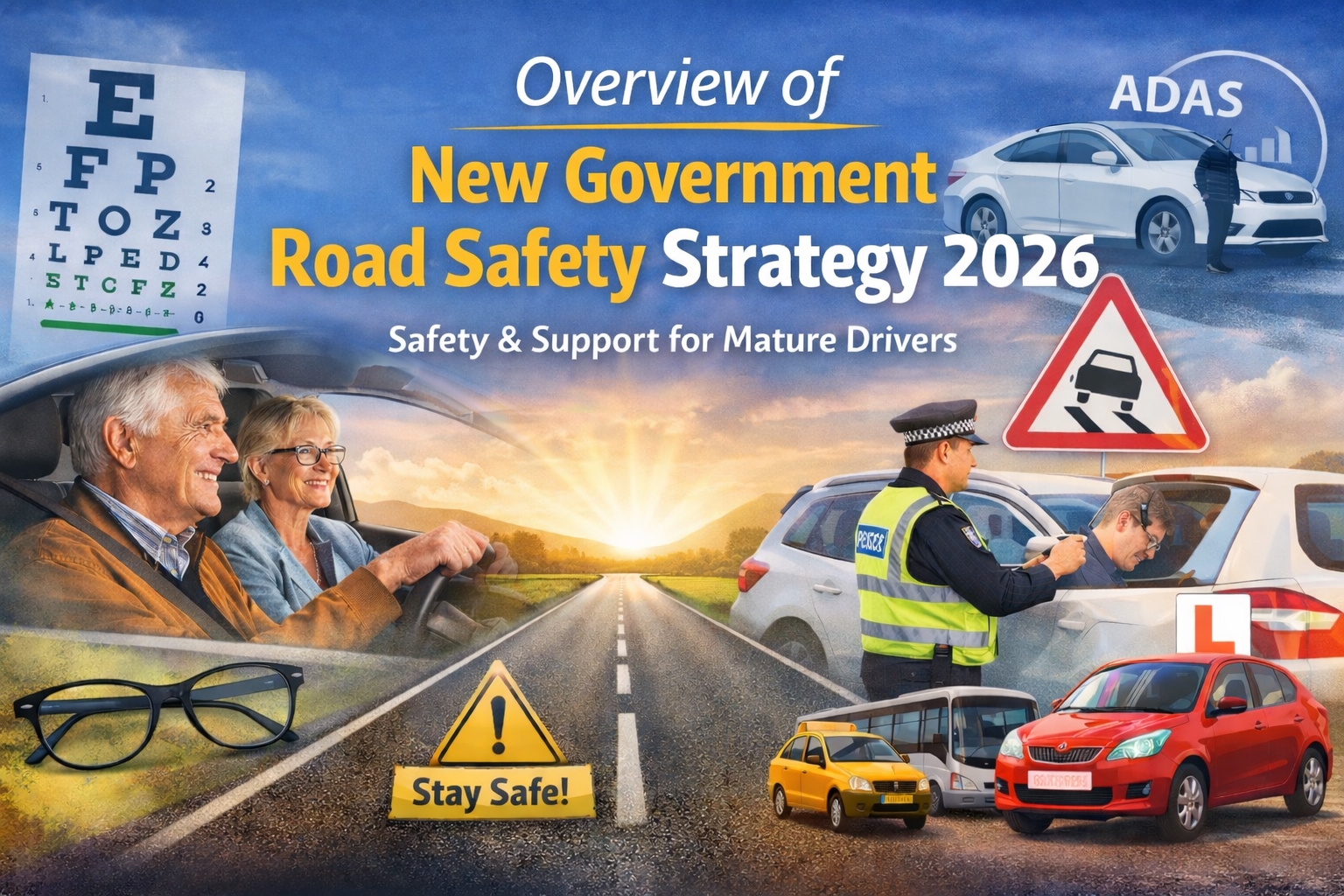
New Road Safety Strategy – Information for Mature and Older Drivers
We recognise that many older drivers may have questions or concerns about the Great Britain Road Safety Strategy 2026 (Press release) and what the proposed changes may mean for them. We want to offer reassurance that these measures are intended to make Britain’s roads safer and fairer for everyone, including those of us in later life. They are not designed to undermine independence or unfairly single out older drivers.
Below is an overview of the key proposals, alongside our perspective on how they support road safety while respecting the confidence, experience, and independence of older motorists.
To read the full report click here The main report is broken down into 4 themes:
- Theme 1 – Supporting road users
- Theme 2 – Taking advantage of technology, innovation and data for safer vehicles and post collision care
- Theme 3 – Ensuring infrastructure is safe
- Theme 4 – Robust enforcement to protect all road users
Reducing Deaths and Serious Injuries
The strategy sets out an ambitious national commitment to:
- Reduce road deaths and serious injuries by 65% by 2035
- Achieve an even greater reduction of 70% for children under the age of 16
Why this matters:
On average, around four people die every day on Britain’s roads, and approximately 80 people are killed or seriously injured daily as a result of road traffic collisions — roughly one every 18 minutes. These figures underline the need for decisive, evidence-based action across the whole driving population.
Older Drivers: Eyesight
One of the headline proposals is the introduction of compulsory eyesight testing at licence renewal from age 70, with further checks at least every three years thereafter. This would replace the current self-declaration system, which can fail to identify gradual changes in vision.
There is also consideration of future cognitive assessments for drivers who have certain medical conditions, with the aim of maintaining safety while supporting continued independence and highlighting the importance of drivers notifying the DVLA if they have a notifiable medical condition, as well reminding medical professionals the importance to inform the DVLA if their patient is unwilling or unable to notify the DVLA.
The strategy also says the government will continue to work closely with the National Police Chiefs’ Council to highlight the importance of regular police roadside eyesight tests for all drivers, ensuring that those drivers who fail to meet the minimum eyesight standards required for driving will have their driving licence revoked by DVLA.
Why this helps
Regular eyesight checks provide reassurance that vision remains at a safe standard for driving. This is intended as a supportive safeguard, not a restriction, and can help identify issues early so that people can continue driving confidently and safely for as long as possible.
The Older Drivers Forum is supportive of this proposal. We recognise and value the fact that the vast majority of older drivers are conscientious and proactive in maintaining their eyesight through regular optometrist visits. However, we also acknowledge that a small number of drivers continue to drive despite their vision no longer meeting the legal standard for safe driving.
Under the current self-certification system, these individuals can remain on the road undetected. Compulsory eyesight testing by a qualified optician provides a reliable and objective way to identify unsafe vision, protecting both drivers and other road users.
Ideally, we would support compulsory eyesight testing for all drivers, beginning at first licence application and continuing at regular intervals — for example, every 10 years at photocard renewal. We hope this is a direction policy may move toward in the future. However, we recognise the practical challenges of introducing such a system immediately for the 6.3 million people who currently hold a driving licence.
Introducing compulsory testing initially for a specific group is a measured and proportionate approach, allowing systems to be tested and refined before any wider rollout. This is particularly appropriate given that from age 60, individuals are entitled to free NHS-funded eyesight tests.
We understand that some older drivers may feel this approach is unfair. However, research consistently shows that eyesight can deteriorate with age — often gradually and without obvious symptoms. DVLA data also shows that licence revocations resulting from police notifications increase significantly from the age of 70. Recent large-scale independent academic surveys have shown that over 85% of older drivers support eyesight testing at licence renewal. In addition, polling conducted during Older Drivers Forum webinars on vision and driving indicates that around 93–95% of older drivers support compulsory eyesight testing.
*(Hawley, C.A. (2021) The views of older drivers on road safety interventions. IAM RoadSmart report for the Department for Transport. September 2021. https://iamwebsite.blob.core.windows.net/media/docs/default-source/research-reports/iam-roadsmart-older-drivers-2021.pdf
Importantly, a driving licence would only be withdrawn if an individual’s eyesight no longer meets the legal standard for safe driving. No one wants unsafe drivers on the road, and regular vision checks can actually help people continue driving for longer by identifying issues early and enabling timely treatment.
The Older Drivers Forum has been working with the National Police Chiefs’ Council (NPCC) since 2022, collaborating with a team of experts and Eye Health UK to support UK police forces with the national campaign ‘Is Your Vision Roadworthy?’. This campaign helps the police to check the eyesight of all drivers or all ages, and it is encouraging to see our work recognised within the strategy.
For more useful information on Vision and Driving visit www.visionanddriving.info
The Forum will actively ask to be involved in future consultations in relation to Vision ad Driving
Older Drivers: Cognitive Checks
The strategy also says consideration of future cognitive assessments for drivers who have certain medical conditions, with the aim of maintaining safety while supporting continued independence and highlighting the importance of drivers notifying the DVLA if they have a notifiable medical condition, as well reminding medical professionals the importance to inform the DVLA if their patient is unwilling or unable to notify the DVLA.
Why this helps
The strategy also recognises the potential role of future cognitive assessments for drivers with certain medical conditions, with the aim of maintaining road safety while supporting continued independence. By highlighting the importance of drivers notifying the DVLA of notifiable medical conditions, and reminding medical professionals of their responsibility to inform the DVLA where a patient is unwilling or unable to do so, the approach helps ensure that mature and older drivers receive appropriate support. This promotes fair, informed decision-making, enables access to guidance or adaptations where needed, and helps drivers continue to drive safely for as long as possible, rather than stopping unnecessarily.
The Older Drivers Forum works closely with Driving Mobility. Driving Mobility supports mature and older drivers by providing independent driving, cognitive, and functional assessments that focus on ability rather than age or diagnosis. Through personalised advice, vehicle adaptation recommendations, and clear reports for the DVLA, they help drivers continue to drive safely for as long as possible, while ensuring fair, evidence-based decisions that protect both road safety and individual independence. To find out more how they can help and assist you click here
Stricter Drink-Drive Limits
The strategy proposes lowering the legal drink-drive limit in England and Wales from 35 micrograms to around 22 micrograms per 100 ml of breath, aligning with Scotland and many European countries. This would mean that even a single alcoholic drink could put a driver over the legal limit. There is also discussion around even lower limits for younger drivers.
Why this helps
Alcohol remains a major contributor to road deaths, accounting for around 15–20% of fatalities. The current limit has been in place since 1967, and England and Wales now have the highest allowable drink-drive limit in Europe.
Lowering the limit would reduce alcohol-related collisions and protect all road users, particularly vulnerable groups such as pedestrians, cyclists, children, and older pedestrians.
We strongly advise not drinking and driving at all. Any amount of alcohol can impair driving ability. Safer alternatives include designated drivers, taxis, or public transport.
Better Support for New and Young Drivers
The strategy includes proposals to consult on introducing a minimum learning period (between three and six months) between passing the theory test and taking the practical driving test. This could include additional training in areas such as night-time driving and driving in adverse weather conditions.
Why this helps
Providing new drivers with greater real-world experience before driving independently reduces collision risk and improves safety for all road users.
The Forum continues to support stronger measures for young drivers, including a Graduated Driving Licence (GDL)system. GDL schemes introduce driving privileges in stages, with temporary restrictions such as limits on night driving or carrying passengers. Evidence from countries such as Canada, New Zealand, and parts of the USA shows that these systems significantly reduce serious collisions among young drivers.
Tackling Dangerous and Illegal Driving
The strategy proposes tougher enforcement and penalties to discourage high-risk behaviour, including:
- Higher fines for uninsured driving
- Penalty points for failing to wear a seatbelt (around 25% of road fatalities involve seatbelt non-use, particularly among rear-seat passengers)
- Enhanced enforcement against drug-driving
- Increased use of technology to identify “ghost plates”, which are deliberately altered number plates designed to evade detection by enforcement cameras
These measures aim to reinforce responsible driving and protect all road users.
Safer Vehicles and Road Systems
The strategy also promotes safer vehicles and a system-wide approach to road safety. It mandates 18 new vehicle safety technologies, including autonomous emergency braking and lane-keeping assistance, ensuring that drivers across Great Britain benefit from consistent safety standards.
The Strategy also highlights the problem of glare from oncoming vehicles. The strategy says the government will undertake further research aimed at identifying what vehicle design factors may be responsible for increased headlamp glare.
Why this helps
Modern safety technology and better road design reduce risks for all drivers, including those with many years of driving experience. We do, however, recognise the importance of clear guidance and training to ensure drivers understand how to use these technologies effectively and confidently.
We are aware as we age that glare from headlights can be a major issue, we are pleased this is being looked at and the hope this will steer future design of vehicles and recommendations for current vehicles.
What This All Means for Older Drivers
We recognise that eyesight and health can change over time, often gradually. These proposals are about supporting safe mobility, not restricting it. Professional checks provide reassurance, promote confidence, and help people remain mobile and independent for as long as possible.
Most older drivers already take their responsibilities seriously and overwhelmingly support sensible measures that improve safety for everyone.
In summary, these changes form part of a long-term strategy to significantly reduce deaths and serious injuries on Britain’s roads by 2035. They aim to make driving safer at every stage of life — from new drivers to experienced motorists — while respecting independence, dignity, and personal freedom.
We are committed to listening, answering questions, and supporting older drivers throughout these discussions. Your safety, confidence, and ability to remain mobile matter deeply to us.
New Road Safety Strategy – Information for Mature and Older Drivers
We recognise that many older drivers may have questions or concerns about the Great Britain Road Safety Strategy 2026 (Press release) and what the proposed changes may mean for them. We want to offer reassurance that these measures are intended to make Britain’s roads safer and fairer for everyone, including those of us in later life. They are not designed to undermine independence or unfairly single out older drivers.
Below is an overview of the key proposals, alongside our perspective on how they support road safety while respecting the confidence, experience, and independence of older motorists.
To read the full report click here The main report is broken down into 4 themes:
- Theme 1 – Supporting road users
- Theme 2 – Taking advantage of technology, innovation and data for safer vehicles and post collision care
- Theme 3 – Ensuring infrastructure is safe
- Theme 4 – Robust enforcement to protect all road users
Reducing Deaths and Serious Injuries
The strategy sets out an ambitious national commitment to:
- Reduce road deaths and serious injuries by 65% by 2035
- Achieve an even greater reduction of 70% for children under the age of 16
Why this matters:
On average, around four people die every day on Britain’s roads, and approximately 80 people are killed or seriously injured daily as a result of road traffic collisions — roughly one every 18 minutes. These figures underline the need for decisive, evidence-based action across the whole driving population.
Older Drivers: Eyesight
One of the headline proposals is the introduction of compulsory eyesight testing at licence renewal from age 70, with further checks at least every three years thereafter. This would replace the current self-declaration system, which can fail to identify gradual changes in vision.
There is also consideration of future cognitive assessments for drivers who have certain medical conditions, with the aim of maintaining safety while supporting continued independence and highlighting the importance of drivers notifying the DVLA if they have a notifiable medical condition, as well reminding medical professionals the importance to inform the DVLA if their patient is unwilling or unable to notify the DVLA.
The strategy also says the government will continue to work closely with the National Police Chiefs’ Council to highlight the importance of regular police roadside eyesight tests for all drivers, ensuring that those drivers who fail to meet the minimum eyesight standards required for driving will have their driving licence revoked by DVLA.
Why this helps
Regular eyesight checks provide reassurance that vision remains at a safe standard for driving. This is intended as a supportive safeguard, not a restriction, and can help identify issues early so that people can continue driving confidently and safely for as long as possible.
The Older Drivers Forum is supportive of this proposal. We recognise and value the fact that the vast majority of older drivers are conscientious and proactive in maintaining their eyesight through regular optometrist visits. However, we also acknowledge that a small number of drivers continue to drive despite their vision no longer meeting the legal standard for safe driving.
Under the current self-certification system, these individuals can remain on the road undetected. Compulsory eyesight testing by a qualified optician provides a reliable and objective way to identify unsafe vision, protecting both drivers and other road users.
Ideally, we would support compulsory eyesight testing for all drivers, beginning at first licence application and continuing at regular intervals — for example, every 10 years at photocard renewal. We hope this is a direction policy may move toward in the future. However, we recognise the practical challenges of introducing such a system immediately for the 6.3 million people who currently hold a driving licence.
Introducing compulsory testing initially for a specific group is a measured and proportionate approach, allowing systems to be tested and refined before any wider rollout. This is particularly appropriate given that from age 60, individuals are entitled to free NHS-funded eyesight tests.
We understand that some older drivers may feel this approach is unfair. However, research consistently shows that eyesight can deteriorate with age — often gradually and without obvious symptoms. DVLA data also shows that licence revocations resulting from police notifications increase significantly from the age of 70. Recent large-scale independent academic surveys have shown that over 85% of older drivers support eyesight testing at licence renewal. In addition, polling conducted during Older Drivers Forum webinars on vision and driving indicates that around 93–95% of older drivers support compulsory eyesight testing.
*(Hawley, C.A. (2021) The views of older drivers on road safety interventions. IAM RoadSmart report for the Department for Transport. September 2021. https://iamwebsite.blob.core.windows.net/media/docs/default-source/research-reports/iam-roadsmart-older-drivers-2021.pdf
Importantly, a driving licence would only be withdrawn if an individual’s eyesight no longer meets the legal standard for safe driving. No one wants unsafe drivers on the road, and regular vision checks can actually help people continue driving for longer by identifying issues early and enabling timely treatment.
The Older Drivers Forum has been working with the National Police Chiefs’ Council (NPCC) since 2022, collaborating with a team of experts and Eye Health UK to support UK police forces with the national campaign ‘Is Your Vision Roadworthy?’. This campaign helps the police to check the eyesight of all drivers or all ages, and it is encouraging to see our work recognised within the strategy.
For more useful information on Vision and Driving visit www.visionanddriving.info
The Forum will actively ask to be involved in future consultations in relation to Vision ad Driving
Older Drivers: Cognitive Checks
The strategy also says consideration of future cognitive assessments for drivers who have certain medical conditions, with the aim of maintaining safety while supporting continued independence and highlighting the importance of drivers notifying the DVLA if they have a notifiable medical condition, as well reminding medical professionals the importance to inform the DVLA if their patient is unwilling or unable to notify the DVLA.
Why this helps
The strategy also recognises the potential role of future cognitive assessments for drivers with certain medical conditions, with the aim of maintaining road safety while supporting continued independence. By highlighting the importance of drivers notifying the DVLA of notifiable medical conditions, and reminding medical professionals of their responsibility to inform the DVLA where a patient is unwilling or unable to do so, the approach helps ensure that mature and older drivers receive appropriate support. This promotes fair, informed decision-making, enables access to guidance or adaptations where needed, and helps drivers continue to drive safely for as long as possible, rather than stopping unnecessarily.
The Older Drivers Forum works closely with Driving Mobility. Driving Mobility supports mature and older drivers by providing independent driving, cognitive, and functional assessments that focus on ability rather than age or diagnosis. Through personalised advice, vehicle adaptation recommendations, and clear reports for the DVLA, they help drivers continue to drive safely for as long as possible, while ensuring fair, evidence-based decisions that protect both road safety and individual independence. To find out more how they can help and assist you click here
Stricter Drink-Drive Limits
The strategy proposes lowering the legal drink-drive limit in England and Wales from 35 micrograms to around 22 micrograms per 100 ml of breath, aligning with Scotland and many European countries. This would mean that even a single alcoholic drink could put a driver over the legal limit. There is also discussion around even lower limits for younger drivers.
Why this helps
Alcohol remains a major contributor to road deaths, accounting for around 15–20% of fatalities. The current limit has been in place since 1967, and England and Wales now have the highest allowable drink-drive limit in Europe.
Lowering the limit would reduce alcohol-related collisions and protect all road users, particularly vulnerable groups such as pedestrians, cyclists, children, and older pedestrians.
We strongly advise not drinking and driving at all. Any amount of alcohol can impair driving ability. Safer alternatives include designated drivers, taxis, or public transport.
Better Support for New and Young Drivers
The strategy includes proposals to consult on introducing a minimum learning period (between three and six months) between passing the theory test and taking the practical driving test. This could include additional training in areas such as night-time driving and driving in adverse weather conditions.
Why this helps
Providing new drivers with greater real-world experience before driving independently reduces collision risk and improves safety for all road users.
The Forum continues to support stronger measures for young drivers, including a Graduated Driving Licence (GDL)system. GDL schemes introduce driving privileges in stages, with temporary restrictions such as limits on night driving or carrying passengers. Evidence from countries such as Canada, New Zealand, and parts of the USA shows that these systems significantly reduce serious collisions among young drivers.
Tackling Dangerous and Illegal Driving
The strategy proposes tougher enforcement and penalties to discourage high-risk behaviour, including:
- Higher fines for uninsured driving
- Penalty points for failing to wear a seatbelt (around 25% of road fatalities involve seatbelt non-use, particularly among rear-seat passengers)
- Enhanced enforcement against drug-driving
- Increased use of technology to identify “ghost plates”, which are deliberately altered number plates designed to evade detection by enforcement cameras
These measures aim to reinforce responsible driving and protect all road users.
Safer Vehicles and Road Systems
The strategy also promotes safer vehicles and a system-wide approach to road safety. It mandates 18 new vehicle safety technologies, including autonomous emergency braking and lane-keeping assistance, ensuring that drivers across Great Britain benefit from consistent safety standards.
The Strategy also highlights the problem of glare from oncoming vehicles. The strategy says the government will undertake further research aimed at identifying what vehicle design factors may be responsible for increased headlamp glare.
Why this helps
Modern safety technology and better road design reduce risks for all drivers, including those with many years of driving experience. We do, however, recognise the importance of clear guidance and training to ensure drivers understand how to use these technologies effectively and confidently.
We are aware as we age that glare from headlights can be a major issue, we are pleased this is being looked at and the hope this will steer future design of vehicles and recommendations for current vehicles.
What This All Means for Older Drivers
We recognise that eyesight and health can change over time, often gradually. These proposals are about supporting safe mobility, not restricting it. Professional checks provide reassurance, promote confidence, and help people remain mobile and independent for as long as possible.
Most older drivers already take their responsibilities seriously and overwhelmingly support sensible measures that improve safety for everyone.
In summary, these changes form part of a long-term strategy to significantly reduce deaths and serious injuries on Britain’s roads by 2035. They aim to make driving safer at every stage of life — from new drivers to experienced motorists — while respecting independence, dignity, and personal freedom.
We are committed to listening, answering questions, and supporting older drivers throughout these discussions. Your safety, confidence, and ability to remain mobile matter deeply to us.



 Older Drivers Forum