
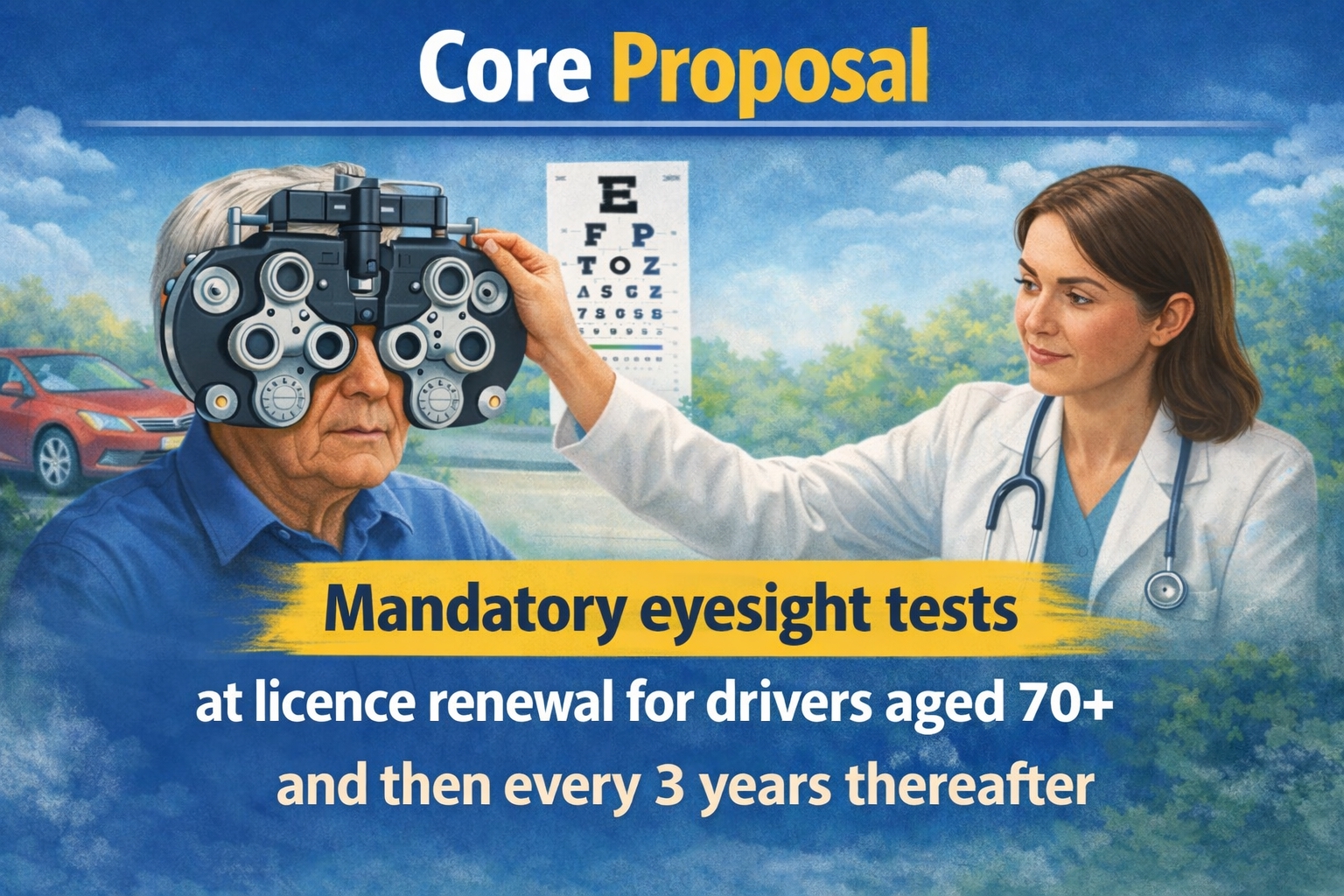
Eyesight, Driver Licensing and Enforcement
Current Framework, System Failures and the Case for Reform
By Rob Heard MBE – 26 February 2026
Click here to download copy of the report shown below
1. Introduction
Good vision is fundamental to safe driving. Around 90% of the information required for safe driving is visual, meaning even modest deterioration can significantly impair hazard perception, reaction time, judgement of speed and distance, and performance in low-light or glare conditions.
Despite this, the current driver licensing and enforcement framework in Great Britain relies heavily on self-declaration and reactive enforcement, rather than systematic, preventive assessment. This paper sets out the current legal position, identifies key shortcomings, and makes the case for proportionate reform grounded in the Older Drivers Task Force (ODTF) evidence base, operational policing learning, and national police eyesight / Fitness to Drive (FTD) assessment programme findings delivered with National Roads Policing Operations, Eye Health UK and academic partners.
2. Current Legal Framework on Driving and Eyesight
2.1 Legal Responsibility
Under current UK legislation and DVLA practice, responsibility for ensuring adequate eyesight rests primarily with the individual driver. Drivers self-declare that they meet the legal vision requirements; the system assumes drivers understand the standard and can accurately self-assess. Evidence shows this assumption is unreliable.
A key structural gap remains: there is no requirement to notify the DVLA when corrective lenses become necessary after licensing, and eyesight changes (including after refractive change or surgery) may therefore go unrecorded and unmanaged unless the driver takes action voluntarily.
2.2 Legal Standards of Vision – Group 1 Drivers
To drive legally, Group 1 (car/motorcycle) licence holders must meet the Standards of Vision, comprising:
- reading a post-September 2001 number plate at 20 metres
- minimum visual acuity of 6/12 (decimal 0.5)
- an adequate field of vision (commonly recognised at ~120°)
Important policy problem: many drivers believe the number-plate test alone is “the standard”, but it is only one element and does not capture the full legal position.
2.3 Contrast with Group 2 drivers
Group 2 (HGV/PCV) drivers face higher standards and are subject to mandatory medical / eyesight assessment at application and renewal. This creates a clear inconsistency: Group 1 drivers share the same roads and risks yet are not subject to any routine formal eyesight testing at any age
3. When Is Driver Eyesight Checked?
For Group 1 drivers with no notifiable medical condition, eyesight is routinely checked only:
- at the practical driving test (number plate test), and
- at the roadside only if police suspect defective eyesight.
It is not checked at licence renewal, including at age 70, and not after gradual deterioration. Drivers can therefore legally drive for decades with no formal eyesight assessment.
4. Critical Gaps and Failures in the Current System
4.1 Absence of Routine Testing
- Group 1 drivers are never required to have a formal eyesight test during their driving lifetime.
- A person may legally:
- hold a provisional licence from age 17,
- drive for many years on a provisional licence,
- without any formal eyesight assessment.
- Informal eyesight checks by Approved Driving Instructors are inconsistent and dependent on access to paid instruction and only check if a driver can read a number plate at 20m.
4.2 Over-Reliance on Self-Declaration
The current system depends on drivers recognising gradual decline and taking action. The Older Drivers Task Force evidence base highlights that eyesight can deteriorate slowly, allowing adaptation without awareness—undermining the reliability of self-certification.
A further risk is avoidance behaviour: the Task Force noted that some drivers either become complacent or avoid eye testing due to fear of losing their licence, meaning unsafe vision can persist undetected unless police intervene.
4.3 Limitations of the Number Plate Test
The number plate test assesses distance acuity only. It does not measure functions critical to real-world safety such as peripheral vision, glare recovery and contrast sensitivity (particularly relevant to junction decisions, night driving and glare conditions).
Evidence shows it is not a reliable or repeatable measure of overall fitness to drive and is particularly inadequate for identifying age-related visual decline.
4.4 Reactive Enforcement and Late Intervention
Police data consistently shows that:
- Sight test failures identified by police increase sharply after age 70. (D751E notifications to DVLA over last 11 years)
- Most failures are identified after offences or collisions, not through prevention.
- Use of Cassie’s Law varies widely between police forces.
- Police can only carry out a roadside test if have suspicion of defective vision, not routinely. They have the power to check a vehicles fitness for the road and the driver’s documentation, but not a person’s medical or cognitive fitness to drive without suspicion.
This indicates a system that intervenes after risk has materialised, rather than preventing harm.
5. Eyesight, Ageing and Risk
Evidence demonstrates that:
- Eyesight deteriorates gradually with age, particularly in:
- visual acuity,
- field of vision,
- recovery from glare.
- Drivers often compensate unconsciously and remain unaware their eyesight has fallen below legal standards.
- Vision is significantly impaired in low light, glare and night-time conditions as we age.
Estimates suggest that:
- We estimate around 5% of drivers at any one time do not meet legal eyesight standards.
- This equates to over 3 million drivers.
- ‘Is Your Vision Roadworthy?’ campaign run over 3 years shows the vast majority of drivers who fail a roadside eyesight test conducted by Police Forces across the UK are aged 70 an above
- Numbers increase during summer months when some drivers wear uncorrected sunglasses.
A practical indicator of hidden risk comes from police-delivered Fitness to Drive pathways: 50% of 550 drivers who undertook a police Fitness to Drive assessment were found to have eyesight that failed to meet the visual standards for driving and required new corrective lenses before proceeding.
6. Older Driver Demographics, Fatalities and Future Risk Exposure
6.1 Rapid Growth in Older Licence Holders
The number of older drivers on UK roads is increasing rapidly. There are currently over 6.3 million drivers aged 70 and over, and this figure is projected to double — and potentially treble — within the next 20 years as life expectancy increases.
Older licence numbers are increasing by approximately 200,000 each year, a trend expected to continue.
The oldest current licence holder is aged 109.
This demographic shift represents a structural change in driver exposure. Even if individual risk remained constant, the absolute number of age-related collisions and fatalities would be expected to rise.
6.2 Disproportionate Fatality Outcomes
Older drivers are not disproportionately represented in overall casualty numbers, but they are significantly over-represented in fatalities.
Drivers aged 70+ account for:
- 15% of all driving licences held
- 11% of all miles driven
- 8% of all casualties
- 24% of all fatalities
This disparity is largely attributable to increased physical frailty with age. Injuries are more serious and recovery is longer, meaning collisions that might be survivable for younger drivers are more likely to be fatal for older drivers.
Casualty rates increase from approximately age 65, and fatality rates increase significantly thereafter.
6.3 Rising Fatalities and Serious Injuries
The longer-term trend is upward:
- Fatalities involving drivers aged 70+ have increased by 45% since 2010.
- Killed and Seriously Injured (KSI) casualties involving this age group have increased by 60% since 2007.
- Fatalities are forecast to increase by 22% by 2040, with KSI casualties forecast to increase by 45%.
Fatalities involving younger drivers have been steadily decreasing, while those involving older drivers are increasing — a trend strongly associated with the rising number of older licence holders.
Without preventive reform, demographic expansion alone will drive further increases in deaths and serious injuries.
6.4 Age-Related Factors Relevant to Vision and Hazard Detection
Evidence shows older drivers are:
- 38% more likely to be involved in collisions due to failure to look properly.
- 55% more likely to be involved in collisions due to failure to judge another person’s speed or path.
- 4.5 times more likely to be involved in collisions where illness, disability or medical factors contribute.
Drivers over 65 take approximately 22% longer to identify and react to hazards.
These characteristics are directly relevant to eyesight decline, contrast sensitivity, peripheral awareness, glare recovery and cognitive processing speed — all functions not adequately captured by the current number-plate test.
6.5 Policy Significance
The vast majority of older drivers are safe and responsible road users. However:
- The cohort is growing rapidly.
- Fragility increases fatality risk.
- Medically related factors are more prevalent.
- Self-declaration becomes less reliable as sensory decline progresses gradually.
The current licensing system was not designed for a population in which millions of drivers continue driving well into their 80s and 90s.
This demographic reality strengthens the case for proportionate, preventive eyesight assessment linked to licence renewal, rather than continued reliance on self-reporting and reactive enforcement.
7. Evidence from the Older Drivers Task Force (2021)
7.1 ODTF recommendation
The Older Drivers Task Force concluded that:
- Voluntary eyesight testing increases with age, yet
- Police-identified eyesight failures rise markedly after age 70.
- A minority of drivers either:
- become complacent about eyesight testing, or
- avoid testing due to fear of licence loss.
Under the current system, these drivers may remain undetected unless stopped by police.
7.2 Public support and behaviour (poll evidence)
Recent polling evidence in the attached consultation response (Older Drivers Forum hosted poll, February 2026, 802 respondents) shows:
- 91% support introducing mandatory eyesight testing for drivers aged 70+ as part of licence renewal
- support is almost identical for those under 70 (90.9%) and 70+ (91.2%)
The same evidence base indicates most older drivers are already engaging with optometry services:
- nearly two-thirds (65%) of drivers aged 70+ report having an eye test every year, with a further third every two years
This matters for policy design: it suggests mandatory testing would formalise and standardise what most people already do, while targeting the minority currently missed.
8. Enforcement, Cassie’s Law and Policing Practice
8.1 Cassie’s Law
Introduced in 2013, Cassie’s Law allows police to:
- Notify the DVLA electronically of a failed roadside eyesight test.
- Facilitate licence revocation within hours.
Despite its effectiveness:
- Awareness and use vary widely between police forces.
- Officers are often reluctant to rely on suspicion-based eyesight checks.
- National data shows that 93% of revocations under Cassie’s Law involve drivers aged 60 and over, with incidence rising sharply after age 70
8.2 Roadside Eyesight Testing Is Reactive, Not Preventive
Police have wide preventive stop powers under Section 163 of the Road Traffic Act 1988, allowing vehicles to be stopped without suspicion. However:
- Eyesight testing can only be required under Section 96, where defective eyesight is already suspected.
- Poor eyesight is rarely obvious, making suspicion difficult to justify.
- Drivers may refuse voluntary tests, often because they suspect they would fail.
- Police can only carry out a roadside test if have suspicion of defective vision, not routinely. They have the power to check a vehicles fitness for the road and the drivers documentation, but not a person’s medical or cognitive fitness to drive without suspicion.
This creates a loophole whereby high-risk drivers can avoid detection until an offence or collision occurs. Suggest introduction of additional power to allow Police to require a roadside eyesight test in good conditions at any time, not just when a suspicion arises.
9. Police Fitness to Drive (FTD) Assessments – Additional Evidence of System Failure
Police Fitness to Drive (FTD) assessments provide further insight into the scale of undetected eyesight problems. Delivered through Driving Mobility–accredited centres, FTD assessments integrate medical, functional and driving performance evaluation.
Evidence from police forces using FTD assessments shows that:
- Eyesight failure is frequently identified as a primary or contributory factor, particularly in drivers aged 70 and over.
- Many drivers referred for FTD assessment were previously unaware that their eyesight no longer met legal standards.
- In some cases, eyesight correction enabled drivers to continue driving safely; in others, early intervention prevented serious harm.
These findings reinforce that police-led detection alone identifies problems too late, and that structured, preventive assessment is more effective than reliance on roadside enforcement alone
10. Barriers for Optometrists and Medical Practitioners in Reporting to DVLA
A further systemic weakness lies in the expectation that optometrists and medical practitioners will report unsafe drivers.
A major weakness in the current model is the assumption that clinicians will (and can) report unsafe drivers. Evidence indicates this rarely happens in practice. For example, a College of Optometrists (2022) survey found 94% of optometrists had never notified the DVLA about a patient’s fitness to drive—highlighting the impracticality of relying on discretionary clinical reporting as a systemic safeguard.
Evidence shows that clinicians face:
- Concerns over patient confidentiality and uncertainty about when disclosure to the DVLA is legally justified.
- Fear of professional complaints or regulatory investigation, particularly where patients dispute findings or refuse consent.
- Damage to the clinician–patient relationship, which can discourage attendance for future eyesight tests.
A recent Inquest in April 2025 in Lancashire where 4 people died because of 3 drivers with defective vision resulted in a Regulation 28 Prevention of Future Deaths reports being submitted which highlighted cases where practitioners identified unsafe vision but felt unable to act decisively, leaving risk unmanaged until police intervention or collision
As a result, responsibility is effectively pushed back onto drivers, despite clear evidence that eyesight deterioration is often unnoticed or denied.
11.The Case for Reform
11.1 Mandatory Eyesight Testing at Licence Renewal
Mandatory eyesight testing at age 70 is a proportionate starting point because:
- it aligns with the existing renewal milestone
- evidence shows failures increase from age 70
Testing would be undertaken by an optometrist or ophthalmic practitioner as a formal “driver eyesight MOT”. Vehicles are routinely MOT-tested; drivers are not.
11.2 Free NHS Eyesight Testing – Accessibility, Proportionality and Opportunity
A critical factor supporting mandatory eyesight testing is the existing availability of free NHS-funded eyesight tests, removing a key barrier to compliance and fairness.
Under current NHS arrangements in England (with similar provision across the UK), individuals are entitled to a free NHS sight test if they:
- are aged 60 or over;
- have diabetes or glaucoma;
- are aged 40 or over with a close family history of glaucoma;
- are advised they are at risk of glaucoma;
- are eligible for an NHS optical voucher; or
- receive qualifying benefits.
As a result, the vast majority of drivers aged 70 and over already qualify for free eyesight testing. Mandatory testing would therefore not impose an additional financial burden.
The reform is also operationally deliverable: the implementation around existing optometry infrastructure and the scale of the cohort as approximately 6.3 million licence holders aged 70 is a manageable group for phased rollout and learning.
11.3 Why NHS Provision Matters for Policy Design
Free NHS provision means mandatory testing would be:
- accessible regardless of income;
- proportionate, building on an existing entitlement;
- deliverable at scale using a national optometry network;
- equitable, avoiding disproportionate impact on disadvantaged groups.
This directly addresses concerns about affordability and fairness.
11.4 The Case for an NHS-Embedded “Eyesight MOT”
The Older Drivers Task Force recognised that NHS testing may need adaptation to support licensing. It recommended that:
“If mandatory eyesight testing at licence renewal is introduced at age 70, the NHS contract for free eyesight tests for those aged 60 and over would need to be amended so that drivers aged 70 and above could receive a more detailed ‘MOT-style’ eyesight assessment.”
This would:
- ensure consistent standards;
- provide clarity for optometrists;
- remove discretionary judgement;
- protect clinician–patient relationships.
11.5 Evidence That NHS Testing Is Under-Used
Despite free testing:
- 40–48% of drivers failing roadside eyesight tests had not had a recent sight test.
- Many were eligible for free testing.
Availability alone is insufficient; licensing-linked requirement is necessary.
11.6 Additional Powers for Police to carry out roadside testing routinely
- Drivers may refuse voluntary tests, often because they suspect they would fail.
- Police can only carry out a roadside test if have suspicion of defective vision, not routinely. They have the power to check a vehicles fitness for the road and the driver’s documentation, but not a person’s medical or cognitive fitness to drive without suspicion.
This creates a loophole whereby high-risk drivers can avoid detection until an offence or collision occurs. Suggest introduction of additional power to allow Police to require a roadside eyesight test in good conditions at any time, not just when a suspicion arises but be able to do routinely like any roadside check they do on a vehicle and a drivers documentation.
12. Benefits of Reform
Reform would deliver:
- Prevention rather than reaction.
- Improved road safety.
- Extended safe mobility for older drivers.
- Earlier detection of eye disease.
- Reduced health, social care and collision costs.
- Increased public confidence in driver licensing.
Starting with drivers aged 70 allows piloting before wider rollout
13. Conclusion
The evidence shows the current system:
- relies too heavily on self-declaration
- fails to detect gradual deterioration
- identifies unsafe vision too late (often after incidents)
- cannot realistically rely on clinician reporting as a systemic safeguard
Mandatory eyesight testing at licence renewal from age 70 is a proportionate, evidence-based and publicly supported reform, deliverable through existing optometry infrastructure and underpinned by NHS sight test entitlement.
 Older Drivers Forum